

Why AI Still Needs Signal Processing: A Geometric Solution for Remote Sensing
Our Remote Sensing research group has a new paper accepted for publication in IEEE JSTARS (Q1, SCIE; Impact Factor: 5.3).
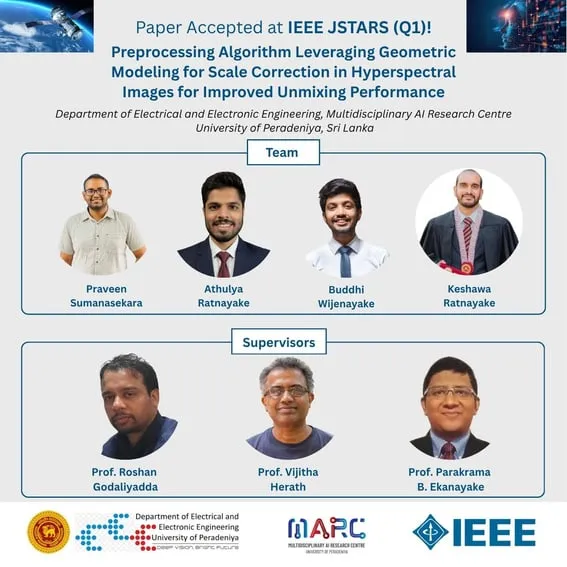
Proud to share that our Remote Sensing research group at the Multidisciplinary AI Research Centre (MARC), University of Peradeniya, has a new paper accepted for publication in IEEE JSTARS (Q1, SCIE; Impact Factor: 5.3).
Our work, “Preprocessing Algorithm Leveraging Geometric Modeling for Scale Correction in Hyperspectral Images for Improved Unmixing Performance”, tackles a fundamental bottleneck in remote sensing and computer vision.
The Problem
Hyperspectral cameras capture incredibly detailed spectral data, but natural variations in illumination and surface topography create massive scale distortions in the pixel signatures. These large-scale distortions often overwhelm even the most advanced AI models, confusing the optimization processes and leading to highly inaccurate material estimations.
The Solution & Impact
Instead of building overly complex, computationally heavy neural networks to guess through the noise, we developed a novel unsupervised preprocessing algorithm. By utilizing a rigorous mathematical framework to restore the fundamental simplex geometry of the data, our algorithm acts like a corrective lens—fixing scale-induced variability before it is ever fed into the unmixing models.
The results? Our preprocessing step consistently achieved abundance estimation error reductions of around 50% across a wide range of state-of-the-art algorithms. This makes existing pipelines vastly more accurate for real-world Geographic Information System (GIS) applications like mineral mapping, precision agriculture, and environmental monitoring.
Driven by Undergraduate Excellence & Alumni Collaboration
This achievement is incredibly meaningful to our lab because the core research was equally driven by our own students during their undergraduate tenure at the Department of Electrical & Electronic Engineering, University of Peradeniya. It showcases the immense strength of UoP’s home-grown talent in producing globally competitive, mathematically grounded AI research.
Core Research Team (Equal Contributions)
- Praveen Sumanasekara
- Athulya Rathnayake
- Buddhi Wijenayake
Collaborator
- Keshawa Lasith (UoP Alumni, currently pursuing his PhD at Purdue University)
Supervisors
- Prof. Roshan Godaliyadda
- Prof. Mpb Ekanayake
- Prof. Vijitha Herath