

Animal-Perceived Seasons from Elephant Movement
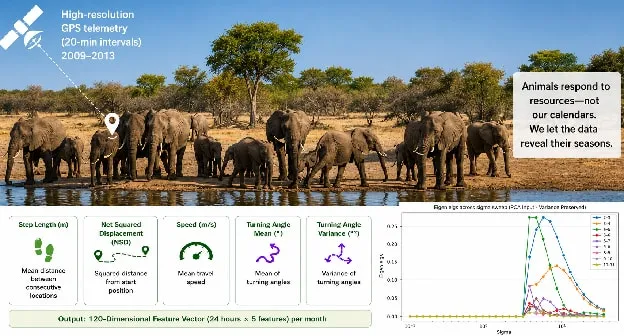
Do elephants follow our seasons or do they experience seasons differently?
Seasonal boundaries are commonly defined using calendars, but animals respond to changing resources, water availability, temperature, and environmental conditions rather than fixed dates. This project introduces a data-driven approach to discover “animal-perceived seasons” directly from elephant movement behavior.
We transform high-resolution GPS telemetry into hourly movement signatures based on net square displacement, distance travelled, speed, and turning behavior. Principal Component Analysis (PCA) then extracts the dominant behavioral patterns from the resulting high-dimensional data, while spectral clustering and eigen-gap analysis identify stable movement regimes without imposing predefined seasonal labels. The analysis reveals clear wet- and dry-season behavioral regimes, while also uncovering transitional states that are less visible under conventional calendar-based classifications. Future extensions will integrate demographic and environmental variables, benchmark alternative clustering approaches, and validate the framework across additional elephants and unseen trajectories.
Ultimately, the goal is to move from describing where elephants move to understanding why and when their movement changes, supporting data-driven wildlife conservation and water-resource management.
Publications
1 paper from this project
Under review
-
Data-Driven Seasonality Discovery in Elephant Movement via PCA-Enhanced Spectral Clustering
Moratuwa Engineering Research Conference 2026