

All-Sky Imaging & Multimodal Solar Irradiance Forecasting
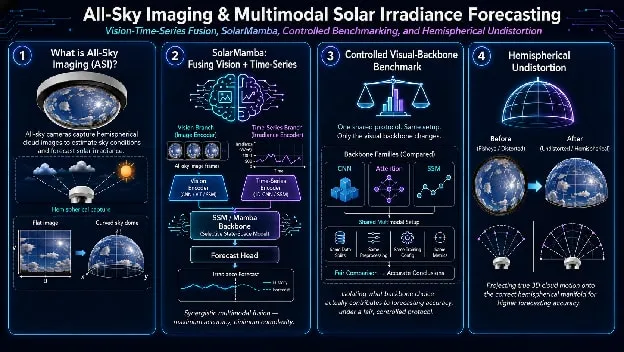
Our research group develops deep learning systems that forecast short-term solar irradiance by fusing all-sky imagery (ASI) with time-series meteorological data. A core theoretical question we investigate is how vision and temporal features can be combined synergistically extracting maximum forecasting accuracy at the lowest architectural complexity, rather than treating spatial cloud structure and temporal irradiance dynamics as separate problems. This led to SolarMamba, an SSM-based backbone that models cloud motion and irradiance sequences jointly. To rigorously identify which visual backbones actually matter for this task, we developed a Controlled Visual-Backbone Benchmark for Multimodal Short-Term Solar Irradiance Forecasting, isolating the contribution of backbone choice under a fair, matched evaluation protocol. A newer theoretical thread tackles a fundamental optical distortion problem: all-sky cameras capture clouds through a fisheye lens onto a flat sensor, warping true cloud geometry and motion. We are researching whether undistorting ASI images by projecting cloud motion onto the correct hemispherical manifold, informing the model of clouds true 3D motion rather than their flattened 2D projection measurably improves downstream forecasting accuracy.
Publications
3 papers from this project
2026
-
A Controlled Visual-Backbone Benchmark for Multimodal Short-Term Solar Irradiance Forecasting
12th international Moratuwa Engineering Research Conference 2026
2025
-
FlowSegModel: Advancing Perception in Autonomous Driving Through Weather-Resilient Segmentation (opens in a new tab)
2025 IEEE 19th International Conference on Industrial and Information Systems (ICIIS)
2024
-
Ego Vehicle Speed Estimation Using Optical Flow Analysis (opens in a new tab)
2024 5th IEEE Global Conference for Advancement in Technology (GCAT)