

Demographic Analysis
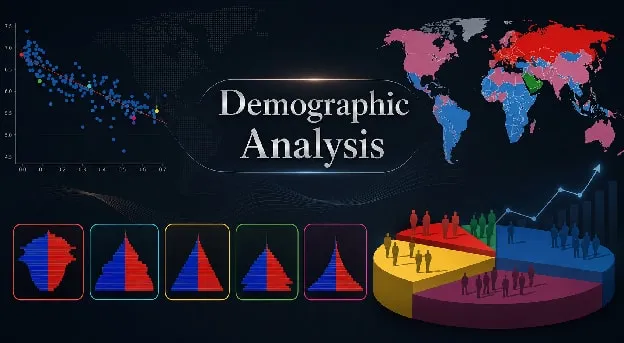
Demographic Analysis is a multidisciplinary research project focused on developing data-driven methods to better understand how population structure influences demographic and public-health outcomes. A central theme of the project is the use of complete population pyramids rather than conventional summary indicators such as median age or the proportion of people aged over 65.
Our work introduced PoPDivergence and PoPStat, information-theoretic and statistical measures that transform complex age–sex distributions into interpretable demographic indicators and relate them to cause-specific mortality across hundreds of diseases and countries. The framework has subsequently been applied to regional mortality analysis and COVID-19 vulnerability, demonstrating that the relationship between population structure and health outcomes varies substantially across diseases and geographical regions. The broader project combines demographic data, statistical modelling, information theory, epidemiology, and large-scale computational analysis to uncover interpretable patterns in population evolution and support evidence-based public-health planning.
Publications
5 papers from this project
2025
-
Correlation Analysis of Age Structure Metrics and Cause-Specific Mortality: A Global and WHO Regional Comparison using the Top 5 Causes of Death in 2021
1st International Conference on Applied Sciences 2025
-
Devising PoPStat: A Metric Bridging Population Pyramids with Global Disease Mortality (opens in a new tab)
-
PoPStat-COVID19: Leveraging Population Pyramids to Quantify Demographic Vulnerability to COVID-19 (opens in a new tab)
International Conference on Advances in ICT for Emerging Regions 2025
Under review
-
PoPStat Versus Conventional Population Metrics: A Multi-Indicator Statistical Benchmark of Demographic Structure and Disease-Specific Mortality
8th IEEE International Conference on Advancements in Computing 2026
-
Unsupervised learning reveals global demographic configurations and national trajectories from population pyramids
Nature Humanities and Social Sciences Communications