

Implicit Neural Representation
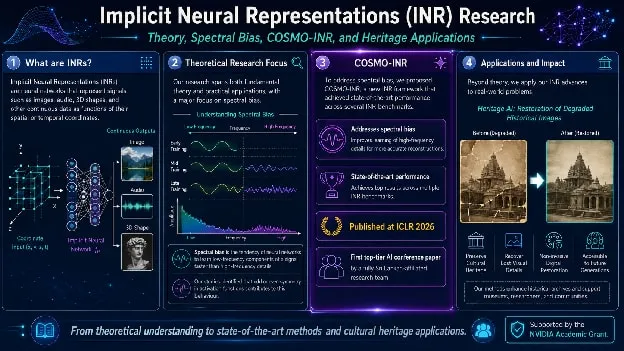
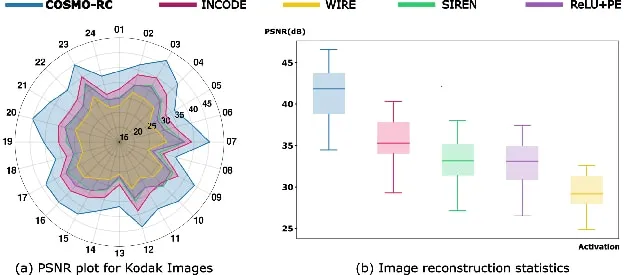
Implicit Neural Representations (INRs) are neural networks that represent signals such as images, audio, 3D shapes, and other continuous data as functions of their spatial or temporal coordinates. Our research on INRs spans both fundamental theory and practical applications. A major theoretical focus is spectral bias, the tendency of neural networks to learn low-frequency components of a signal faster than high-frequency details. Through our studies, we identified that odd or even symmetry in activation functions contributes to this behaviour. To address this limitation, we proposed COSMO-INR, a new INR framework that achieved state-of-the-art performance across several INR benchmarks. COSMO-INR was published at ICLR 2026, marking the first top-tier AI conference paper produced by a fully Sri Lankan-affiliated research team. Beyond theory, we apply our INR advances to real-world problems, including restoration of degraded historical images for cultural heritage preservation through the Heritage AI project, supported by the NVIDIA Academic Grant.
Publications
5 papers from this project
2026
-
COSMO-INR: Complex Sinusoidal Modulation for Implicit Neural Representations (opens in a new tab)
The Fourteenth International Conference on Learning Representations (ICLR 2026)
2025
-
From Samples to Functions: Implicit Neural Representations for Continuous Modeling (opens in a new tab)
19th International Conference on Industrial and Information Systems (ICIIS) 2025
2024
-
Comparison of Appliance Signature Classification Methods for Non-Intrusive Load Monitoring (opens in a new tab)
2024 4th International Conference on Electrical Engineering (EECon)
Under review
-
CoRe-INR: Coordinate Rescaling for Spectral Expansion and Convergence Improvement for Implicit Neural Representations
The Fifteenth International Conference on Learning Representations (ICLR 2027)
-
From Parallelism to Specialisation: SSA-Guided Multi-Branch Implicit Neural Representations
The Fifteenth International Conference on Learning Representations (ICLR 2027)